
Consistency through Softening: What Mindfulness Taught Me About Setting Expectations Low
By: Bong Lau
For many of us, the hardest part of a mindfulness practice isn’t understanding why it matters—it’s figuring out how to make it consistent in the midst of full, demanding lives. I’ve spent years starting and stopping practices, convinced that the problem was my lack of discipline or commitment. What I’ve come to realize instead is that the obstacle was expectation.
This realization crystallized for me during a BIPoC meditation retreat at Spirit Rock, a retreat center north of San Francisco. For six days, we followed a strict and beautiful rhythm: 45 minutes of sitting meditation, 45 minutes of walking meditation, then sitting again, then walking again—all in silence. There were no phones, no conversations, no distractions. Just breath, body, and mind, over and over again.
As an educator, I entered the retreat with a familiar mindset: growth comes from stretching, from setting high expectations, from pushing through discomfort. That framework has served me well in many areas of my life. So I naturally applied that same logic to meditation. More time, more effort, more discipline would surely lead to deeper insight and transformation.
At the end of the retreat, during the closing, one of the teachers offered a piece of advice that completely upended my assumptions:
Set your expectations low.
I was stunned. After six days of intense, rigorous practice, this was the takeaway?
The teacher went on to explain that many of us bring our most punishing tendencies into the spiritual realm. We don’t just fail at meditation—we fail morally. We judge ourselves for distracted minds, for missed days, for not feeling calm or enlightened. We can do meditation “badly” in ways that quietly reinforce self-criticism rather than compassion.
Instead, the teacher suggested committing to just one breath.
One breath. That’s it.
The invitation wasn’t to lower our aspirations, but to remove the conditions that make us abandon practice altogether. If the commitment is one breath, success is always possible. And something unexpected happens when we succeed: one breath often becomes two. Two becomes five minutes. Five becomes fifteen. Not because we forced ourselves, but because we were already there.
That teaching changed how I think about consistency. It reframed consistency not as rigidity but as relationship—one that can be sustained through softness, the opposite of being hard on myself.
Once I saw consistency this way, the insight began to ripple outward into other areas of my life, especially my teaching practice. I started noticing how often I pushed myself to finish all my grading, preparation, or classroom organization in one prolonged stretch, even when my body and mind were clearly asking for rest.
At the same time, I began to notice the other end of the spectrum. When teaching completely depleted me, even a single mindful breath or a brief practice could have supported my wellbeing far more than hours of numbing out as a coping mechanism. Approaching consistency with greater softness helped me become a careful observer of my own experience. Through self-awareness over time, I began to gather my own data—learning which routines truly restored my energy and vitality. And when I chose to veggie out instead, I practiced meeting that choice with kindness rather than judgment.
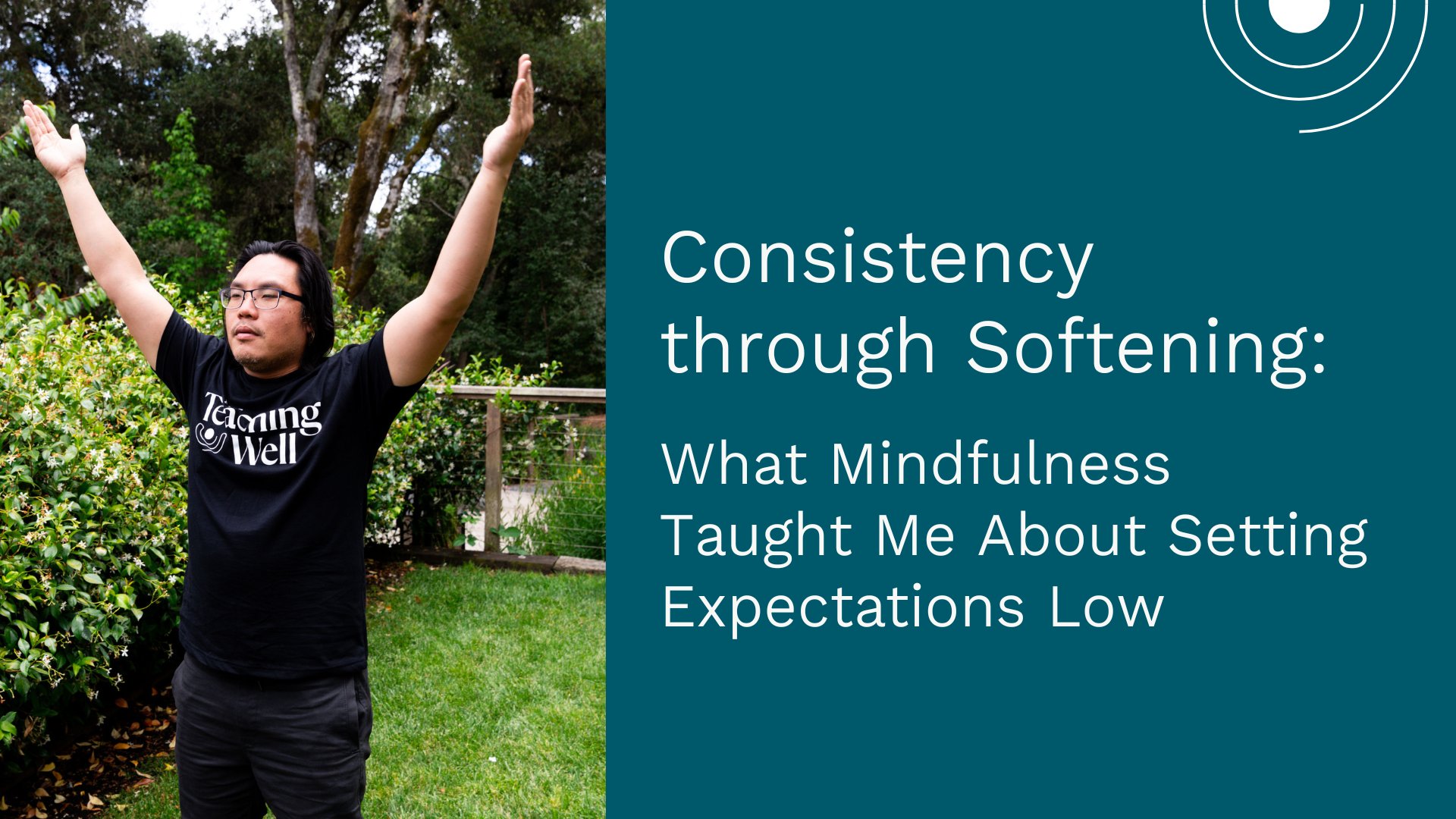
It was within this growing spirit of curiosity and gentleness that Qi Gong entered my life, offering a natural and embodied space to practice consistency through softening rather than striving.
Qi Gong is an ancient, indigenous movement meditation from China that synchronizes breath with intentional movement. It supports circulation, balance, and overall well-being, and it carries a deep philosophical lineage rooted in harmony and flow. When I first encountered Qi Gong, I felt a deep resonance with it. Grounding and expansive at the same time, this moving meditation met my body where it was.
Naturally, I told myself I would practice Qi Gong every day.
And just as naturally, that plan fell apart.
Some days my body was tired. Other days my schedule was packed. On the days I missed, a familiar voice crept in: If you really cared, you’d make time. You’re doing this badly. Slowly, Qi Gong began to carry the same weight of expectation and guilt that meditation once had. The practice itself hadn’t changed—but my relationship to it had.
Remembering the Spirit Rock teaching, I paused and asked myself a gentler question:
What would it look like to set expectations low here?
The answer surprised me. Daily Qi Gong didn’t fit the fullness of my life—and that didn’t mean I was failing. It meant I needed a rhythm that was honest. Instead of insisting on an idealized version of consistency, I shifted my commitment to practicing Qi Gong when I went to the gym.
That adjustment did two powerful things. First, it honored my body’s needs and my real schedule. Second, it softened the shame cycle. I wasn’t “behind” or “off track”—I was simply practicing in a way that worked.
Ironically, lowering my expectations made my practice more consistent, not less. I showed up more regularly because the practice felt supportive instead of demanding. It became something I looked forward to, not something I owed.
What mindfulness, meditation, and Qi Gong have taught me is this: consistency doesn’t come from pressure. It comes from permission. Permission to start small. Permission to adapt. Permission to be human.
In a culture that constantly tells us to do more, be better, and push harder, setting expectations low can feel radical—even irresponsible. But in practice, it’s an act of deep wisdom. It creates space for sustainability, curiosity, and care.
If you’re struggling to maintain a mindfulness practice, I invite you to experiment. What is your “one breath?” What is the smallest possible commitment that still keeps the door open? You may find, as I did, that consistency begins not with effort, but with softness that has a way of carrying you further than hard force ever could.
Want to try on Qi Gong for yourself? Practice alongside me in this video…